Abstract
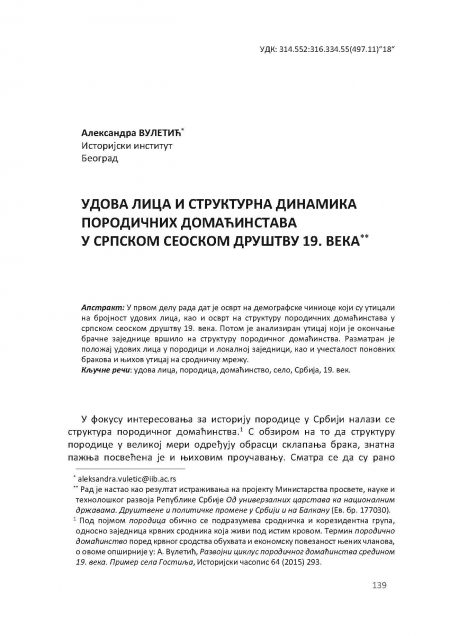
The forms of entering into the first marriage and habitation of a young married couple are usually observed as the key factors in defining the prevalent system of formation and structure of a family household. The principle of patrilocality implied joint habitation and earning of a young married couple and the groom’s primary family, at least at the start of the marriage, which led to the appearance of extended and complex family households. However, a change in the household structure was influenced also by relatively high mortality of the population in the fertile and working age, and remarrying of widowed persons. In the early 1880s, a fifth of marriages were those where one or both partners had previously been widowed. High mortality rates indirectly led to higher nuptiality, while remarriages contributed to higher natality. Widowed persons thus accelerated the dynamics of structural changes of family households, while their remarriages served the functions of maintenance and reproduction of biological and economic functions of the family. A large number of remarriages also made the family network more complex. Affinal kinship, established through remarriages between members of two families, was not always respected in practice in the extent to which other forms of kinship were respected, which complicated mutual relations in village communities.
Information
| Published in | Београд |
| Year of publication | 2017 |
| Author | Александра Вулетић |
| Publisher | Историјски институт Београд и Музеј на отвореном Сирогојно |
| Publication | Село Балкана. Континуитети и промене |
| Pages | 139 - 155 |
| Keywords |
|
How to cite this publication:
Istorijski Institut, portal Žene kroz istoriju. "УДОВА ЛИЦА И СТРУКТУРНА ДИНАМИКА ПОРОДИЧНИХ ДОМАЋИНСТАВА У СРПСКОМ СЕОСКОМ ДРУШТВУ 19. ВЕКА". Access date: 16. October 2026. URL: https://zristorija.iib.ac.rs/en/istrazivanja/udova-lica-i-strukturna-dinamika-porodicnih-domacinstava-u-srpskom-seoskom-drustvu-19-veka-2/