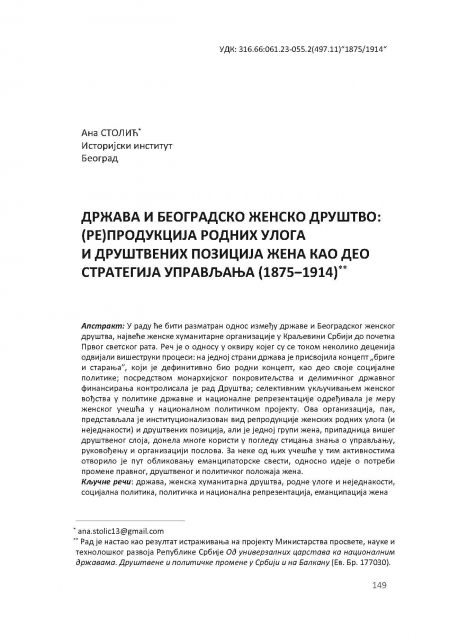
Abstract
This paper analyzes the relationship between the state and the Belgrade Female Society, the largest women’s humanitarian organization in the Kingdom of Serbia until the beginning of World War I. It was а relationship within which several processes occurred over several decades: the state assumed the concept of “concern and care”, which was definitely a gender concept, as part of its social policy; through monarchic patronage and partial state funding, the state controlled the work of the Society; by selective inclusion of women’s leadership in the state and national politics of representation, it determined the rate of women’s participation in the national political project. However, this Society was an institutionalized form of the (re)production of female gender roles (and inequality) and social position, although a group of women from higher social classes had certain benefits, in terms of acquiring knowledge about governance, management and organization of work. For some of them, the participation in these activities paved the way for the creation of an emancipatory consciousness, and/or for the idea of the need to change the legal, social and political status of women.
Information
| Published in | Београд |
| Year of publication | 2017 |
| Author | Ана Столић |
| Publisher | Историјски институт Београд |
| Publication | Држава и политике управљања 18-20. век |
| Pages | 149 - 173 |
| Keywords |
|
How to cite this publication:
Istorijski Institut, portal Žene kroz istoriju. "ДРЖАВА И БЕОГРАДСКО ЖЕНСКО ДРУШТВО: (РЕ)ПРОДУКЦИЈА РОДНИХ УЛОГА И ДРУШТВЕНИХ ПОЗИЦИЈА ЖЕНА КАО ДЕО СТРАТЕГИЈА УПРАВЉАЊА (1875‒1914)** (en translation)". Access date: 16. October 2026. URL: https://zristorija.iib.ac.rs/en/istrazivanja/drzava-i-beogradsko-zensko-drustvo-reprodukcija-rodnih-uloga-i-drustvenih-pozicija-zena-kao-deo-strategija-upravljanja-1875%e2%80%921914-en-translation/